
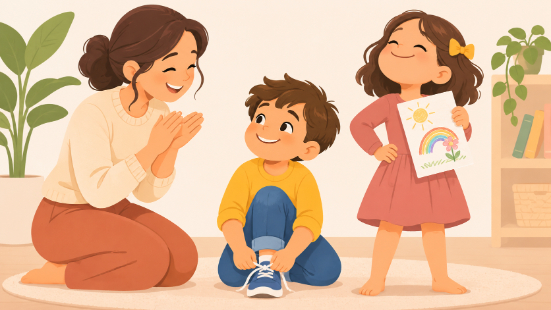
Even in the midst of missing shoes, unfinished homework and uneaten dinners, there is much that parents want for their children. They want their kids to feel loved, to have a good sense of self and to be able to handle life’s ups and downs.
Being a perfect parent doesn’t exist and that’s okay. Simply doing a bunch of things over and over again to promote happiness in kids and their confidence is the key.
1. Give Them Your Full Attention, Even for Ten Minutes
Don’t assume your child needs to go out for fun, or to get treats. Sometimes they just need you to look up from what you’re doing and be with them for a short period of time.
Imagine you’re busy making a meal when your child launches into a long story of what happened in school today. You really don’t have time to be listening to this whilst you’re searching for the ingredients for the meal. But to listen fully for just 10 minutes sends a very powerful message to your child – that what matters to them matters to you.
These small moments of attention can mean more to your child than an entire outing.
2. Let Them Do Things Their Own Way
Watching your child struggling to zip up their own coat or to solve a puzzle can be very trying. Many parents would give in and help their little ones within minutes.
The child’s confidence grows when they are given the opportunity to try to do things for themselves.
If your little one wants to make his own sandwich, allow him to do so. His sandwich may not look so great, the counters may get messy but your child will learn that he is capable.
Offer them help if they ask, be safe and if not, then let them figure it out!
3. Praise Effort, Not Just Results
Congratulating children when they succeed is easy but avoiding them when they fail is so much harder. Long-lasting, deep-seated confidence comes not from praise but from children recognizing their own effort.
Thank you for helping children learn to value hard work. “I see how hard you worked on those spelling words” or “You kept trying to get it right even though it was very difficult” lets children know that you value their effort.
Even if your child does not master riding a bike until months after they first have tried it, they will want to hear about how long it took and all the perseverance involved.
Honor their hard work, too.
4. Make Room for Big Feelings
Children can get worked up over the smallest things (e.g. the blue cup is dirty, their friend sat next to someone else on the bus).
Just because you don’t see something as a big deal doesn’t mean your child doesn’t.
Don’t say “Stop crying. It’s not a big deal.” Instead say “I can see that you are very disappointed. Tell me about it.”
It is possible to teach children to deal with disappointment and still set limits. For example: “I know you’re very upset right now, but we can’t have another cookie. Maybe we can have a cookie later?”
Children who feel heard have a better sense of how to manage their own feelings of disappointment.
5. Give Them Jobs That Matter
Children feel needed and valued when they are given real jobs to do.
Like to help in the kitchen, packing lunch for school or even planning a family meal. Young children can sort and match socks, for example.
Even if the towels end up being folded up in oddly shaped piles, try not to re-fold them in front of your child.
Just as children enjoy being cared for by their family members, children also enjoy being of help to their family members in order to develop an understanding of the value that they bring to their families.
6. Be Careful How You Talk About Yourself
Remember, kids are listening!
By the way, how do you think your kids perceive you? If your kids hear you say “I’m so terrible at…” or “I look so awful today,” then your kids will start to talk to themselves with the same awful self-talk.
Have your children hear another way to respond to mistakes. For example, “That didn’t work. I’ll try another way tomorrow.”
Admitting to hard days and ways you handle things is far more beneficial to your children than pretending everything is always just fabulous.
7. Make Space for Fun and Connection
Not every moment has to be a learning experience. There are lots of silly things about having fun together as a family and being a family that bring lots of joy and need to be savored and celebrated along the way.
MUST remember to have FUN! And lots of laughter too!
Play games and let them win. Choose a game that they want to play with you and be sure to laugh at the silly rules that they make up to play the game. You don’t have to be good at games in order to have fun.
Children need to feel loved for who they are, good and bad.
Remember, You’re Raising a Person, Not a Perfect Child
Yes, happy children still cry. Yes, confident children are still worried from time to time.
What matters is that children are raised in a home where they feel safe enough to try, make mistakes and even speak up when they feel that something is not quite right. They should be able to be who they are.
Start small. Listen a little longer today. Let your child do one thing by themselves tomorrow. Tell your child you love them without tying that to an achievement.
Over time those moments of connection become something bigger – a child who knows you love them and can find their way through life.